Ion traps are devices that allow for the trapping of individual electrically charged particles. These can range from charged speckles of dust, to much smaller particles atomic ions.
How does a trap work?
By removing one electron from an atom, it becomes a positively charged ion. Due to its charge, it responds to electric fields, which can be generated, for example, by applying a voltage onto a piece of metal (an electrode).
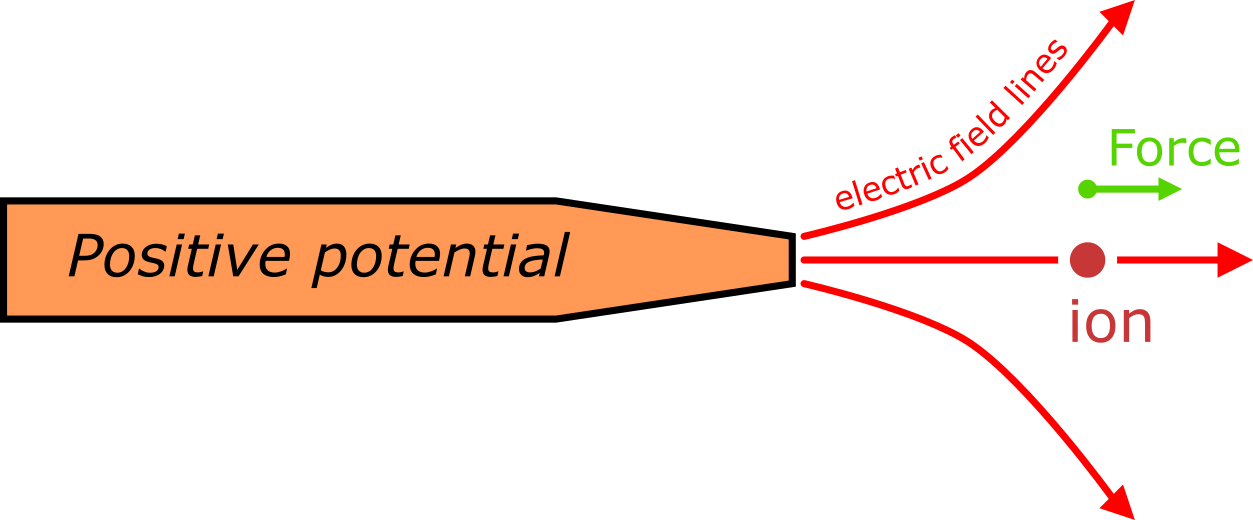
Therefore, we see that we can use electric fields to apply a force on an ion, and we can think about how we may go about to try and trap one. We start by adding a second electrode opposite to the one shown in the figure.
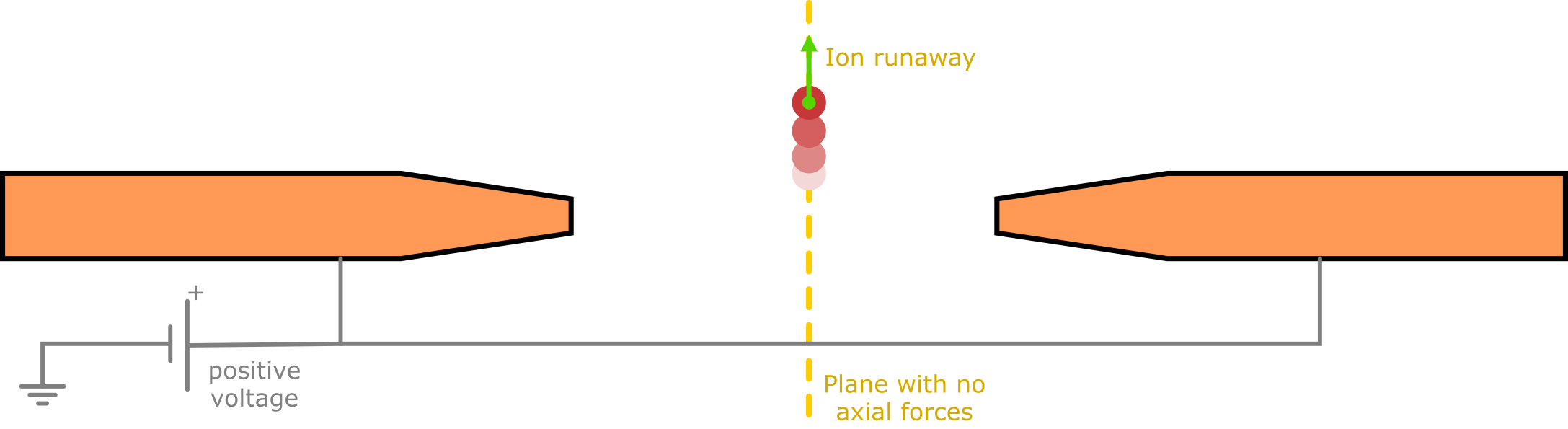
The combined effect of the two electrodes creates a plane where there are no axial forces. However, the ion is still free to run away in the transverse plane, as shown in the figure. One-dimensional trapping is not sufficient in a three-dimensional world. We may think that the solution is add a lot more electrodes to cover all the directions, but it turns out that the ion will find another way to escape. This is guaranteed by the first Maxwell’s law,
\[\nabla \mathbf{E} = 0,\]which is to say that in vacuum it is impossible for the electric field to point inwards in all places, which is exactly the condition required for trapping.
However, we should not let Maxwell stop us, and we - more precisely Mr Paul - can devise a clever way to trap the ion nonetheless
The clever solution to trap ions
The trick will be to add a second potential, which is no longer static. Although at any given time the total potential will not be confining, the effect of time averaging the fastly varying added potential will yield an effictively confining trap.
This potential is generated by four electrodes with voltages as follows,
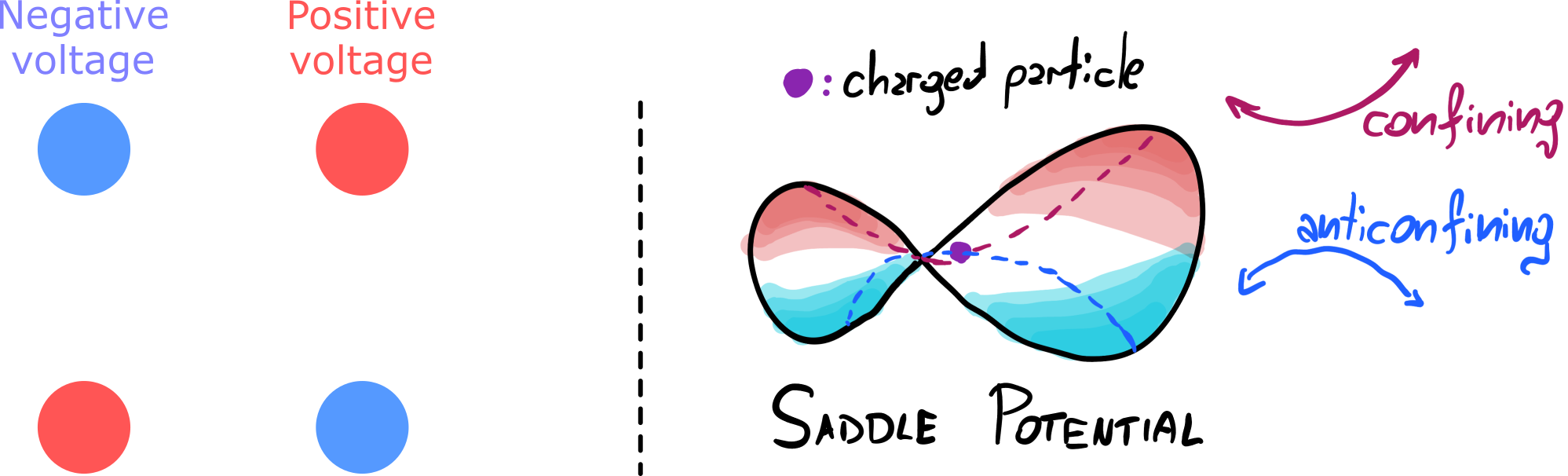
which create a saddle potential. This is a potential landscape which is confining in one direction (the direction of the posotive-voltage electrodes), and anticonfining in the other. Let’s look at the motion of a charged particle in this potential, when we rapidly flip the voltage of the electrodes between positive and negative so that the saddle begins to “flap”.
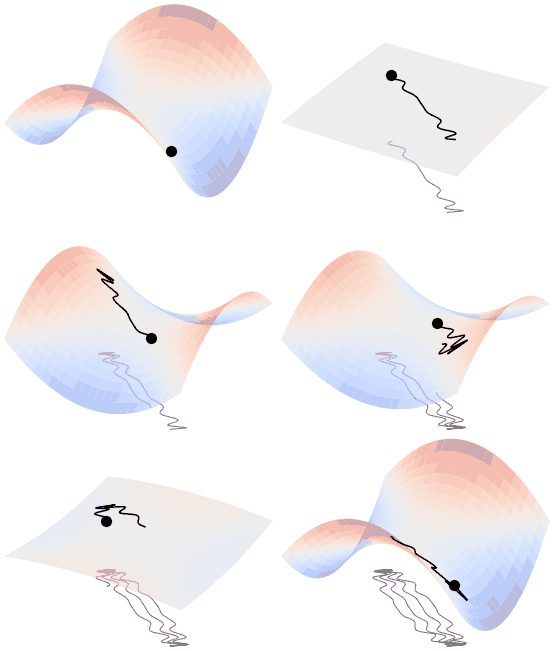
As shown in the simulation above, this dynamic potential seems to be offering a confining effect (and it does indeed!). We can recognise motion on two times scales. A rapid motion follows the period of the flapping, and it is referred to as micromotion. A slower oscillation back and fro is what is known as secular frequency. The mathematical description of the motion of an ion confined in such potential is given by the Mathieu equations, which can be studied to find what combination of trap parameters (e.g., the flapping frequency) lead to stable confinement.
Putting it all together
The combination of electrodes at fixed voltage (end-caps) and the rapidly changing voltage applied on the four electrodes (quadrupole electrodes), allows one to confine ions in space. The end-caps confine the ion in one direction, whereas the quadrupole electrodes guarantee confinement in the plane transverse to it.
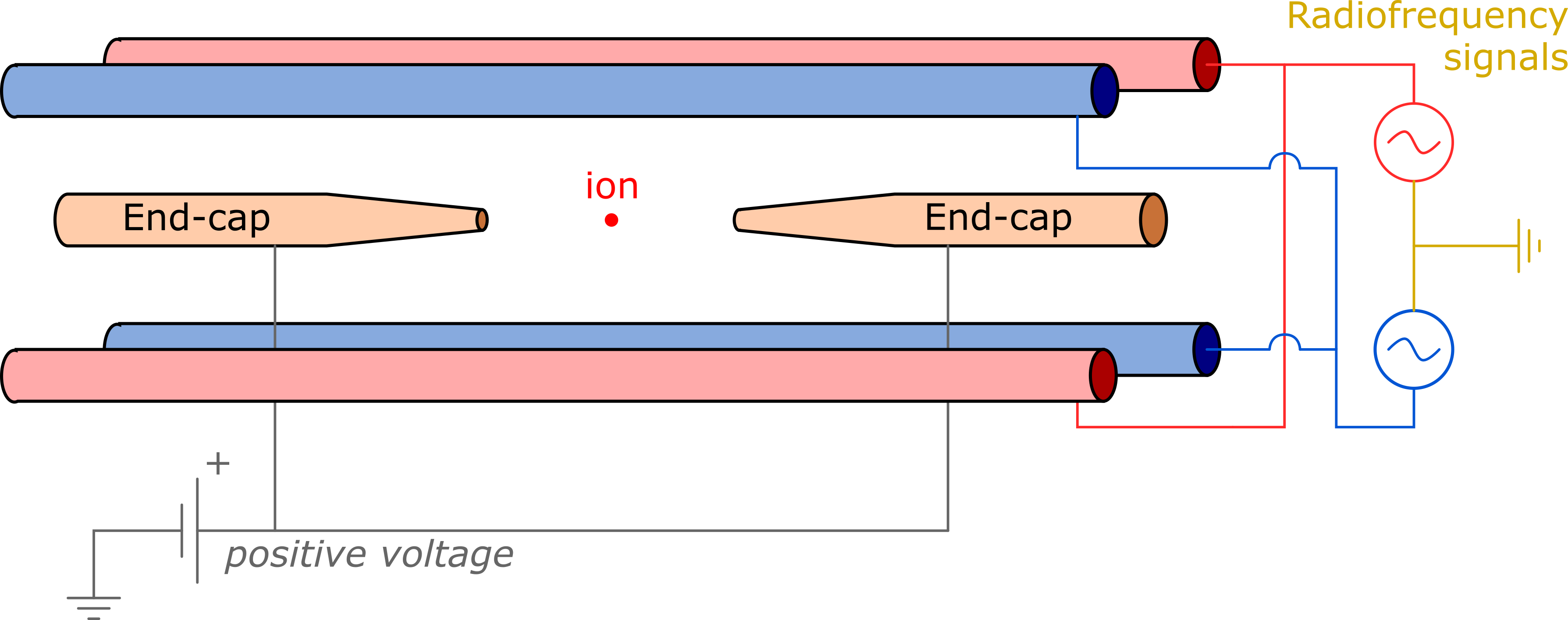
The diagram above shows a typical configuration of electrodes. In practical atomic-ion traps, the saddle flaps millions of times per second, which corresponds to a radio frequency of some megahertz. Fort this reason, this type of trap is called a radiofrequency (RF) trap or a Paul trap, after its inventor Wolfgang Paul. Paul was awarded the physics Nobel prize for this invention, which was truly ground breaking and enabled lots of amazing research.
Vacuum chambers
Ion traps for atomic ions are integrated in a vacuum chamber, an air-tight enclosure that is evacuated by mean of pumps. This is because any significant pressure inside it would lead to collisions of the ion with the background gas, which could lead to a transfer of kinetic energy (the ion leaving the trap), or chemical reactions which could transform the ion in an undesired molecule.
The trap I built
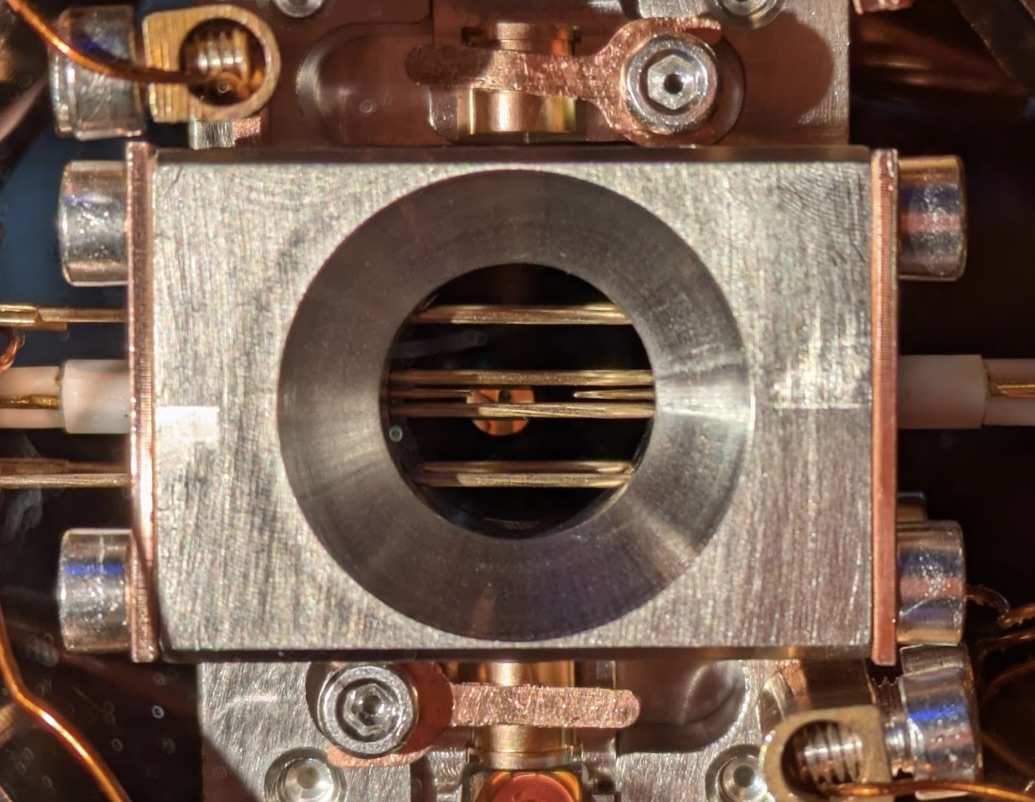
This is an image of the ion trap I built in my DPhil. You can recognise some of the electrodes of the diagrams above. In this trap, there are four additional electrodes, which I refer to as “compensation electrodes”, which allow to tweak the position of the ion to compensate for unwanted stray electric fields.
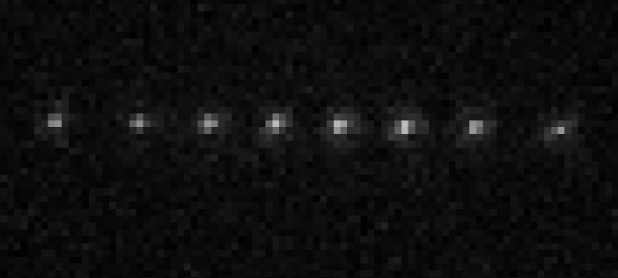
And here is an picture of eight ions trapped within it! These are single individual atoms suspended in space, that can be seen live in the trap! How cool is that?